Get Daily AI News Without the Hype: MetAI Launches "AI Tsushin"
On October 25, 2026, MetAI released its free AI news portal, "AI Tsushin." Using a proprietary system to verify news gathered from approximately 70 sources, the portal delivers daily updates in Japanese, English, and Spanish.
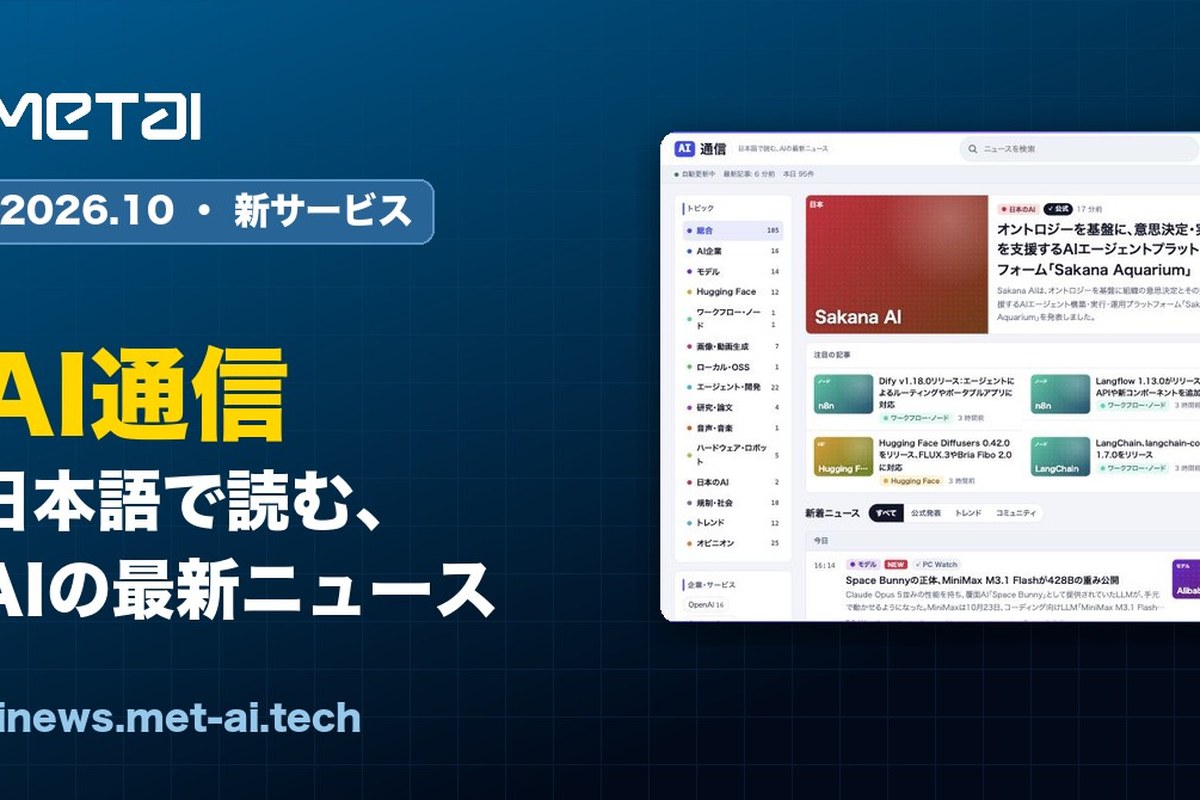
AI News That Makes You Want to Ask, "Is That Really True?"
When you open social media in the morning, you are met with posts like "New model takes first place in all performance tests" or "This profession is no longer needed." When you get curious and look into it, you find the original announcement didn't actually say that much. The numbers were measured only under convenient conditions, and tracing the source reveals it was just someone's personal opinion. If you follow AI, you have likely had this experience at least once.
The world of AI moves fast, and there is too much information. Major AI companies release new models, open-source (software where the blueprints are public and anyone can use it) models are uploaded to Hugging Face almost every day, and in image generation communities, workflows and LoRA (additional data used to teach a model a specific art style or subject) are shared one after another. It is no longer realistic to try to follow all of it yourself.
The problem isn't just the sheer volume. It is that true stories, rumors, and exaggerations all flow through your feed looking exactly the same.
Therefore, on October 25, 2026, MetAI launched the AI news portal "AI Tsushin" (AI News). In this article, we will introduce what kind of service AI Tsushin is, what it can do, how we select our news, and why we created it.
What is AI Tsushin?
AI Tsushin is a portal site where you can read the latest news regarding AI for free.
• URL: https://ainews.met-ai.tech/
• Cost: Free
• Languages: Japanese (standard), English, and Spanish. You can switch between them with a single button.
• Updates: Daily
We cover topics such as announcements from AI companies, new models, workflows and nodes (the units used to connect processing components in tools like image generators), and trending movements on Hugging Face and Civitai. We gather a wide range of information, from topics applicable to business to detailed technical information for those running AI on their own computers.
Why we implemented three languages
The reason we added support for English and Spanish in addition to Japanese is that AI information spreads across national borders. When you want to send an article to an overseas colleague or business partner and say, "Give this a read," you can have them open the same page in their own language. Conversely, you can use it to verify information that first appeared in the English-speaking world in Japanese. MetAI aims to avoid being confined to an information space limited only to Japanese.
What You Can Do with AI Tsushin
Organized into 12 Themes
News is divided into 12 themes, such as:
• AI Companies
• Models
• Workflows & Nodes
• Hugging Face
• Image & Video Generation
• Local & OSS
• Agents & Development
• Research & Papers
• AI in Japan
• Regulation & Society
In addition, there are themes such as Hardware & Robotics and Audio & Music. Depending on your role, you can start reading from the sections most relevant to you—for example, those in management or planning might look at "AI Companies," "Regulation & Society," and "AI in Japan"; creators might focus on "Image & Video Generation" and "Workflows & Nodes"; and engineers might dive into "Agents & Development" and "Local & OSS."
Trends: See What's Growing at a Glance
In "Trends," you can see a summary of projects and models gaining attention on GitHub, Hugging Face, and Civitai. This serves as a window to notice what is "starting to be used on the ground" before it even becomes a news article.
While news reports on "what has happened," Trends reflects "where people are actually putting in the work." By looking at both, it becomes easier to distinguish between things that are merely being talked about and things that are actually gaining traction.
Opinion: Read Explanatory Articles from note
We also include the explanatory and analytical articles that MetAI writes on note in AI Tsushin. We hope you can use this two-step approach: grasp the facts through the news, and then use the opinions to consider "how that relates to your own work."
Favorites, Social Media Sharing, and RSS
You can save articles you want to read later to your Favorites. We also support sharing via social media. RSS (a system for receiving site updates through a dedicated app) is available in Japanese, English, and Spanish, so you can add it directly to the RSS reader you already use.
How We Select Our News
This is the most important part of AI Tsushin.
① Gathering from approximately 70 sources close to primary information
We use about 70 information sources. These include official corporate blogs, release notes (explanations of changes during software updates), research institutions, and specialized media, from which we collect information automatically. Rather than picking up trending posts on social media, our fundamental principle is to start as close to the original publisher as possible.
② Filtering out exaggerations and unsubstantiated claims
The collected articles are put through MetAI's proprietary verification system. Articles centered on sensationalist expressions or those written based on impressions with little factual basis are filtered out at this stage.
③ Cross-referencing numbers and names with original articles
We cross-reference the sources, numerical values, company names, and proper nouns appearing in the articles with the original announcements. Furthermore, information that could not be verified is labeled as "unconfirmed" (mikakunin), and information that has only been announced by a company itself without third-party verification is noted as "self-reported" (jiko shinkoku).
For example, when there is an announcement stating that "a new model significantly outperforms its competitors," AI Tsushin writes it in a way that makes it clear that those figures are based on the developer's own announcement. We are not denying the announcement; rather, we do this so that readers can judge for themselves how much they should trust that information.
④ Humans review anything that causes hesitation
Articles that the automated system cannot judge with confidence are not published as-is. They are published only after being reviewed by a person. This is a system where we do not leave everything to automation, but instead use human eyes for difficult judgments.
⑤ Writing articles in a local environment that does not export data
While the article text is written by AI, that work is performed in an internal local environment that does not send data to external parties. We have applied the philosophy that MetAI values in its other services to our news production as well.
If you find a mistake
Even with repeated verifications, we cannot reduce mistakes to zero. If you notice an error or have a source you would like us to add, please let us know via the MetAI inquiry page or the AI Tsushin "Corrections" page. We believe that providing a contact point to fix mistakes from the very beginning is part of being a reliable news source.
Why I Created the AI Newsletter
Up until now, while developing AI-powered creative tools and web services, MetAI has been writing about the movements of AI on note. Throughout this process, one thing I have consistently felt is that the time spent verifying information takes much longer than the time spent gathering it.
Every time I hear about a new model, I open the official announcement, check the numerical conditions, and compare Japanese articles with the original English texts. While this is part of our job, it is a significant burden for many people who do not make AI their primary profession. As a result, people tend to either "stop following it because it's too confusing" or "believe flashy headlines at face value."
I believe both approaches are a waste. If understood correctly, AI is a tool that can fundamentally change how you work. However, if you make judgments based on incorrect premises, you might end up paying for tools you don't need or, conversely, missing out on technologies that would actually be useful.
I created the AI Newsletter to take on as much of this "burden of verification" as possible on our end. Rather than prioritizing the speed of news delivery, I prioritize providing content that readers can consume with peace of mind.
Here is how you can use it
Here are a few examples of how to use it.
For business professionals who want to grasp the big picture in 10 minutes every morning: skim the main news via the "Daily Digest" delivered to your email every morning, and only visit the site to read the stories that catch your interest. If you see labels like "unconfirmed" (mikakunin) or "self-reported" (jiko-shinkoku), make sure to mention that when sharing the information within your company.
For creators who want to test new models or workflows: check what is trending on Civitai or Hugging Face under "Trends," and read up on the background information under themes like "Image/Video Generation" or "Workflows/Nodes." Add anything you want to try to your favorites.
For developers and engineers: subscribe to "Agents/Development," "Local/OSS," and "Research/Papers" via RSS to integrate them into your usual information-gathering routine. Use GitHub Trends to find out about rising projects early on.
For teams working with overseas members: share the same articles in Japanese, English, and Spanish to reduce discrepancies in understanding caused by language differences.
What You Can Do Starting Today
First, please try opening the site
https://ainews.met-ai.tech/
You can read all the news for free without even registering. Try using the button in the top right to switch languages and see how the same news story is conveyed in three different languages.
Subscribe to the Daily Digest
You can receive a free email summarizing the day's main news, choosing from Japanese, English, or Spanish. You can stop the delivery at any time. Rather than leaving your AI information to the whims of social media timelines, this is recommended for building a habit of receiving information in a consistent, daily format.
Develop the habit of asking, "Is this information reliable?"
Regardless of whether you use AI Tsushin, when reading AI news, please try to consider "who is saying this?" and "who measured those numbers?" The "unconfirmed" (mikakunin) and "self-reported" (jiko-shinkoku) labels in AI Tsushin should help you cultivate that habit.
Summary
• AI Tsushin is a free AI news portal released by MetAI on October 25, 2026.
• It supports Japanese, English, and Spanish, which can be switched with a single button.
• You can read news across 12 different themes, trends from GitHub, Hugging Face, and Civitai, and explanatory articles from note, all in one place.
• News gathered from approximately 70 sources is verified through a proprietary system to strip away hyperbole, clearly labeling content as "unconfirmed" (mikakunin) or "self-reported" (jikoshinkoku). Anything ambiguous is verified by humans.
• Daily email delivery is also free and can be unsubscribed from at any time.
The pace of AI development will continue to accelerate, and the volume of information will keep growing. That is precisely why I believe there is a need for a place where one can calmly verify the facts. I would be delighted if you could use AI Tsushin as one of your daily destinations for checking AI information. We also welcome your opinions and any corrections you may have.
References
• MetAI "Launched the AI news portal 'AI Tsushin'" (October 25, 2026): https://www.met-ai.tech/ja/blog/26-10-25---ai-tsushin-launch/
• AI Tsushin: https://ainews.met-ai.tech/
🧪 Trial section. Opinion piece originally published in Japanese on note.com and translated into English and Spanish for everyone.
Read the Japanese original on note (MetAI) ↗More in Other
- How I Turned My Home Security Camera into My Own App Without Writing a Line of Code
- An Era Where Cars Can Be "Analyzed" by AI: Where Do We Draw the Line to Protect Lives?
- Exhibited at NIIGATA AI EXPO 2026: AI Virtual Humans running on a single PC received a huge response
- The era of choosing sref after seeing it: Free directory "Sref Explorer" released
- 5 Things to Decide Before Giving Meta's "Muse" the Keys to Your Work